
Johnson Auto Body has published new consumer guidance explaining what drivers should know about possible underbody damage after a collision. The October resource focuses on damage that may not be visible from a normal walk-around inspection and identifies conditions that can warrant closer evaluation following an impact.
The guidance expands on Johnson Auto Body’s collision repair information by focusing specifically on the underside of a vehicle, where protective panels, suspension components, exhaust parts, structural areas, fluid lines, and other vehicle-specific components may be located.
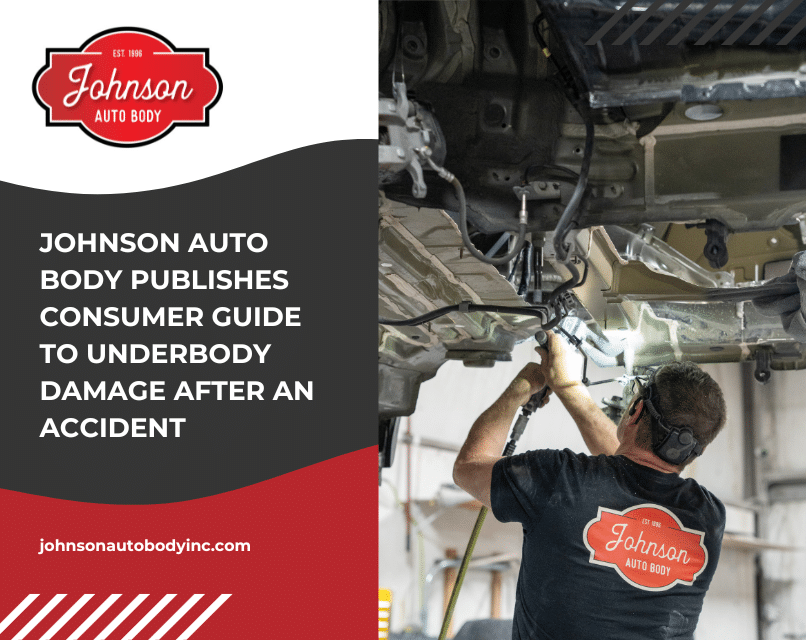
The resource places practical driver observations near the beginning of the guidance. After an accident, visible fluid beneath the vehicle, new handling or steering behavior, unusual noises, or components hanging beneath the vehicle can indicate that further evaluation is appropriate. These observations do not establish the extent of collision damage on their own, but they can provide useful information when documenting what changed after the impact.
For electric and hybrid vehicles, the guidance emphasizes additional caution around the underside because high-voltage components may be located there depending on vehicle design. Drivers should avoid touching exposed or visibly damaged electrical components after a collision. Evaluation and repair requirements vary by vehicle and should follow the information applicable to the specific model.
Johnson Auto Body’s auto body repair information provides additional context about evaluating collision-damaged vehicle components before developing the repair plan.
The October guidance organizes potential underbody damage around three factors: where the impact occurred, what components are located in that area, and what conditions are documented during inspection.
Impact location provides the starting point. Driving over road debris, striking a curb, entering a ditch, or experiencing a collision that forces part of the vehicle over another object can place forces on areas beneath the vehicle. Front, side, and rear collisions can also involve lower portions of the vehicle depending on the direction and severity of the impact.
The location alone does not establish that an underbody component was damaged. Instead, it helps identify which areas may be relevant to the collision assessment.
Vehicle construction is the second factor. The underside is not identical across makes and models. Components and protective coverings can be positioned differently, and electric, hybrid, and internal-combustion vehicles can have substantially different underbody layouts. Technicians can use vehicle-specific information to identify the components and procedures relevant to the affected area.
The third factor is the condition documented during evaluation. Inspection can identify visible deformation, displaced components, damaged protective panels, fluid leakage, or other accident-related conditions where present. Findings can then be incorporated into the developed repair plan rather than assuming that every underbody impact produces the same type of damage.
The October resource also explains why underbody damage can be less obvious to consumers than damage to a door, bumper, fender, or quarter panel. Many areas underneath the vehicle are difficult to view while it is sitting normally on the ground, and some components can be partially concealed by shields or covers.
For that reason, the absence of obvious exterior body damage does not by itself describe the condition of the underside. At the same time, the guidance avoids treating every curb strike or impact as evidence of concealed damage. Evaluation remains dependent on the circumstances of the collision and the condition of the individual vehicle.
Underbody conditions can also become relevant to other portions of collision repair. If an impact involves the wheel or lower body area, technicians may need to consider nearby suspension, steering, structural, or body components as part of the repair plan. Which areas require attention depends on what is documented and the procedures applicable to the vehicle.
The newly published October guidance is intended to give consumers a more structured way to describe and understand this less-visible category of collision damage. Rather than relying solely on whether damage can be seen while standing beside the vehicle, the resource directs attention to post-impact changes, impact location, vehicle construction, and documented inspection findings.
Additional information about the company and facility is available through Johnson Auto Body’s Knightdale location resource.
The central point of the October guidance is that underbody collision damage cannot be determined solely from a vehicle’s exterior appearance. Observable changes after an impact can provide useful context, while the specific vehicle, impact area, and documented conditions determine which components require further evaluation or repair.
Johnson Auto Body is a locally owned collision repair business founded in 1996. The company provides collision repair and auto body repair services for Knightdale, Raleigh, Wendell, and surrounding Wake County communities. Its facility is located at 821 H & R Drive, Knightdale, NC 27545.
###
For more information about Johnson Auto Body Inc, contact the company here:
Johnson Auto Body Inc
Todd McGee
(919) 217-2887
todd@johnsonautobodyinc.com
821 H and R Dr, Knightdale, NC 27545

